|
June
2008
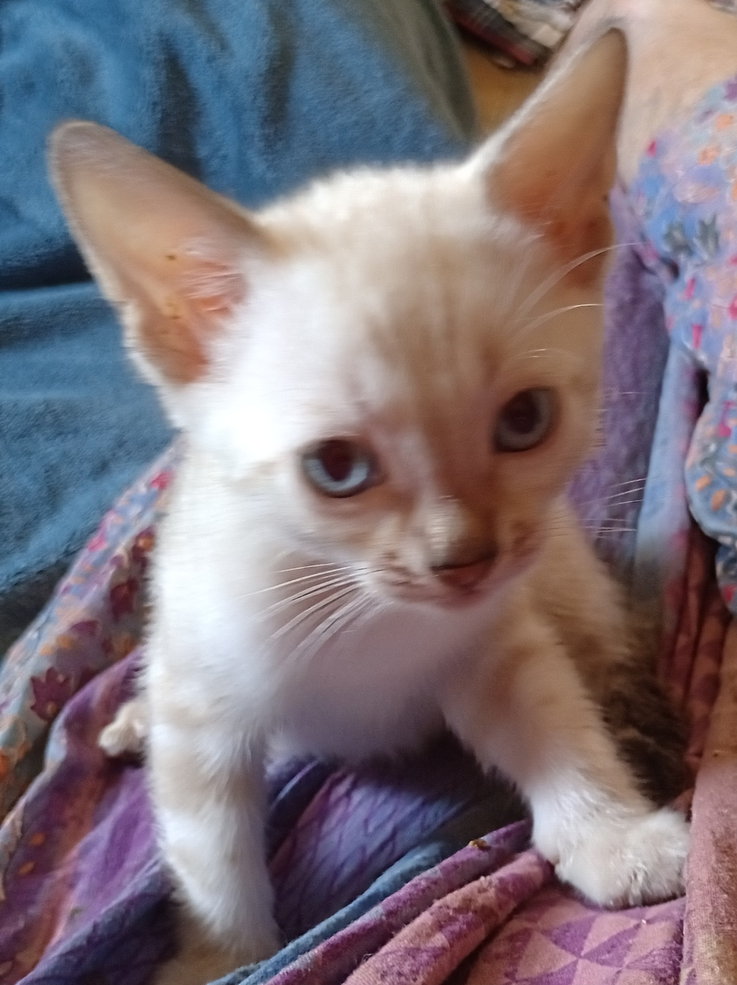
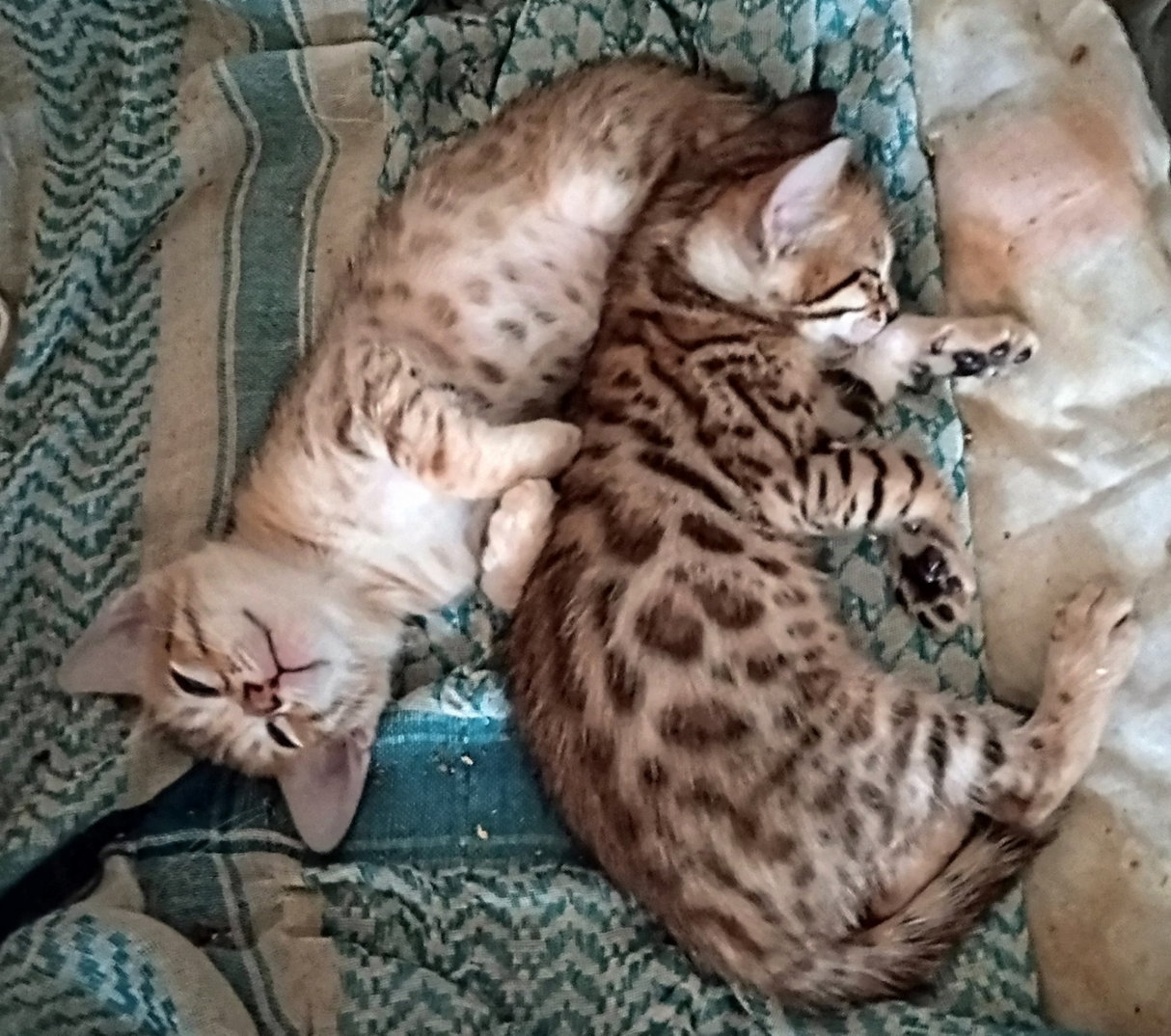
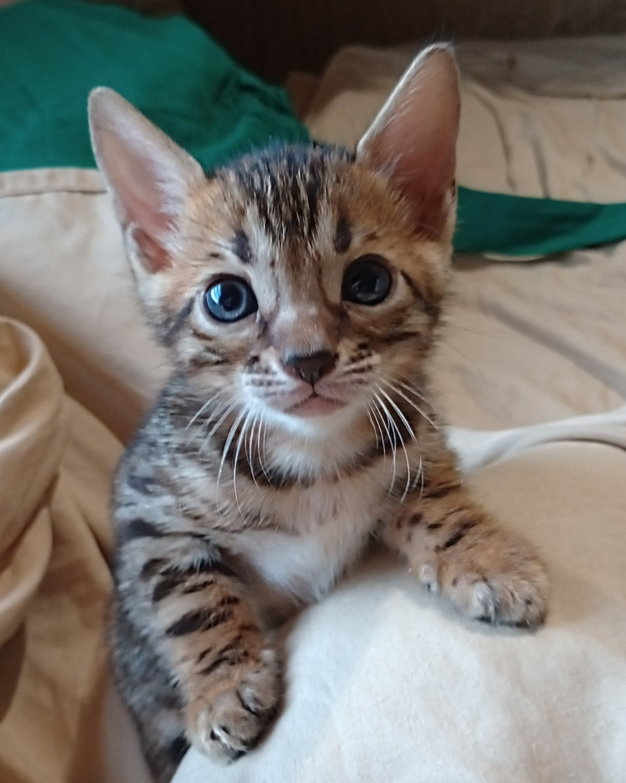
Bengal kittens available ![]() Leo, rosetted, glittered brown male ![]() Leo's mom is Mahogany Rose. ![]() Hello! I'm Leo ~ ~ ~ ~ ~ ~ ~ ~ ~ ~ ~ ~ ~ ~ ~ ~ ~ ![]() Silvia, silver spotted female with "Fuzzies" grandfather is Cloudwalker. ![]() Beautiful silver spotted, rosetted girl, mother is Misty. All kittens have nice spots, and rosettes =============================== First shots and health record included. =============================== Available Soon... marble boys, brown spotted girls and boys |
General Information
m
Studs: Zorro / Cloudwalker / Brutis Queens: Dominique / Crystal / Rose / Misty / Sparkle Princesses: Delta Dawn
![]() Hey! What in the world is "Glitter"?
What
causes it? Where does it
come from?
Only Bengal Cats have it. There is an excellent
article about Glitter and where it came from at the The International
Bengal Cat Society. Don't forget to bookmark
us before you go.
While we're at it, What the heck are the "Fuzzies"?
Shortly after 2 weeks of age,
most Bengal kittens develop a long coat of "guard hairs", usually black
or dark gray, that pretty much obscures their dramatic spotted
appearance. Most kittens lose much of this coat between four to five
months.This is why, when you go to pick up your "beautiful spotted kitten" at 10 to 12 weeks of age, that you chose out of a pile when they were two weeks old, it looks like something someone found in an alley. Don't despair. Most of them will look like that at that age. Trust your breeder and do your research. Many breeders won't let you choose a kitten until they grow out of the "Fuzzies". You can still see the markings from the back, however, through the hair coat. I believe that it is a natural camoflauge to protect the kittens from predators, as they begin to venture out of the nest and into the world. By four to five months of age, they are pretty much in control of their legs and have learned what to run from and when. If anyone has a better theory, I'd be happy to hear it. Marbled kittens rarely grow this hair. A
Short Bengal History
The Bengal Cat is a new, exotic breed of domestic cat originally created by the breeding of the small, wild Asian Leopard Cat, (Felis Bengalensis) with a domestic cat such as the Abyssinian, American Shorthair, Burmese, or Egyptian Mau. According to the 1941 Cat Fancy publication, the first hybrid cross with the intention to create a pet "leopard" was accomplished in Japan. It was not until 1960 that any records exist in the United States of breeding Leopard Cats to domestic cats. Not until the 1970's was any effort was made to create the Bengal breed. The Bengal breed allows those of us who love and admire wild cats, to live with and enjoy their beauty and uniqueness in our own homes, while also benefiting from the domestic Bengal Cat's loving, friendly, playful disposition. Domestic Bengal Cats are no different than any other domestic cat when it comes to care and feeding. Female Bengals average from 7 to 11 pounds at maturity, while the more heavily muscled males can average from 11 to 18 pounds at maturity. Bengal
cat owners delight
in the
intelligence,
playfulness, and affectionate natures of their companions, and also
love
to talk about their athleticism, leaping ability and the dexterity with
which they use their paws. Many Bengals also have an instinctive love
of
water, and have been known to climb in the shower or bathtub with their
humans! "A Bengal cat is an athletic animal, alert to its surroundings; a friendly, curious, confident cat with strength, agility, balance and grace. It is a medium to large cat which exhibits a very muscular and solid build. Female Bengals are generally smaller than males and exhibit proportionately similar qualities. Its wide nose with prominent whisker pads and large oval, almost round eyes in a slightly small head enhance the wild appearance and expressive nocturnal look. Its very slight, to nearly straight, concave profile and relatively short ears with the wide base and rounded tips add to the Bengal's distinctive and unique appearance. The coat area is one of the most distinguishing features of the Bengal cat. The short, dense coat, displaying either a randomly spotted or marbled pattern, has a uniquely soft and silky feel. The coat may be glittered or not glittered, with neither type to be given preference. A thick, low-set, medium-length tail adds balance to the cat." (From TICA Bengal Breed Standard.)------------------------------------------------------- The wrong way to have Bengal Cats: I had wanted a
beautiful spotted cat for years and when the opportunity came by, we
bought a female snow spotted kitten from a very nice breeder in our
area. We make a
mistake but I wanted the kitten so bad I ignored the warning signs.
First, we had to run it to ground with a goat carcass and a net....No, it wasn't really that hard but it was a real trick to get the wild creature in tow after the purchase was made. The breeder's kittens were raised "underfoot" and it had been running loose around this lady's home and to say it was on the wild side was a gross understatement. Thinking back, a goat carcass might have helped. This
kitten, when caught, squalled and shrieked all the to the car and all
the way home. It was one of the longest rides of my life. It calmed
down after a few days under the couch and the befriending by our older
cat Radar. He was delighted and just knew we had gotten her for him.
Nikita (an appropriate name) never got to be lovey-dovey but soon took
over the house and "allowed" us to pet her on her terms only. No
picking up without hideous squalling. Occasionally she would step down
out of her ivory tower to grace us with her presence on the couch, but,
"no unauthorized touching!"
When the time came
for her to have her first litter, I took her back to
the breeder who paired her up with a suitable male. Three months later
she was still a maiden. The next time the breeder brought the male to
us. She finally got pregnant the
third time around!!! Three years after I bought her, she had her first
live kitten. In the mean time, the breeder felt so sorry for me that
she loaned us another female and that sweet cat promptly had a litter
of beautiful kittens, one of whom became the ancestor of our present
line.
What happened to
Nikita and her kitten? Motherhood was just not in the
cards for that cat. I had her spayed and adopted out to a wonderful
family who was grateful to have the, now, somewhat tamed and subdued
beauty. Her kitten was a real pill. It was cross and somewhat wild from
the beginning, as if it was always saying "I didn't ask to be born". No
amount of holding, play and petting seemed to make any difference. Even
in the photographs I took, it looked nasty and defiant. I ended up
giving her to a person who had had a cat of the same temperament years
before and she actually missed that cat a lot. Yikes! This just proves
there is someone for everyone.
Moral of this story: My advice for prospective
cat purchasers is:
If it doesn't feel right, don't press the issue. Bengal cats are hybrids, and still have a trace of that wild blood in their veins. Sometimes it will show up in a kitten many generations separated from the wild ancestor. Look for sweetness at a young age and a willingness to be your friend. Don't settle for less. |
Reference
Queen![]() Duchess |
Reference
Sire Cloud Walker's Dad is a Quadruple Grand Champion AMERIKATZ OCILA CLOUD OF STARBENGAL ![]() He is owned by Earl Shropshire of Starbengal. |
![]() Marble Ann |
(I wish I had him and I know he isn't for sale.) Father of Zorro ![]() RW QGC DiCaprio of Starbengal DiCaprio is a quadruple Grand Champion and is owned by Earl Shropshire of Starbengal in San Diego County. His color is called "Brown Spotted", just like Shyanne, above. There is a world of difference between the two, but they are labled the same. Confusing, isn't it? |


|
|